
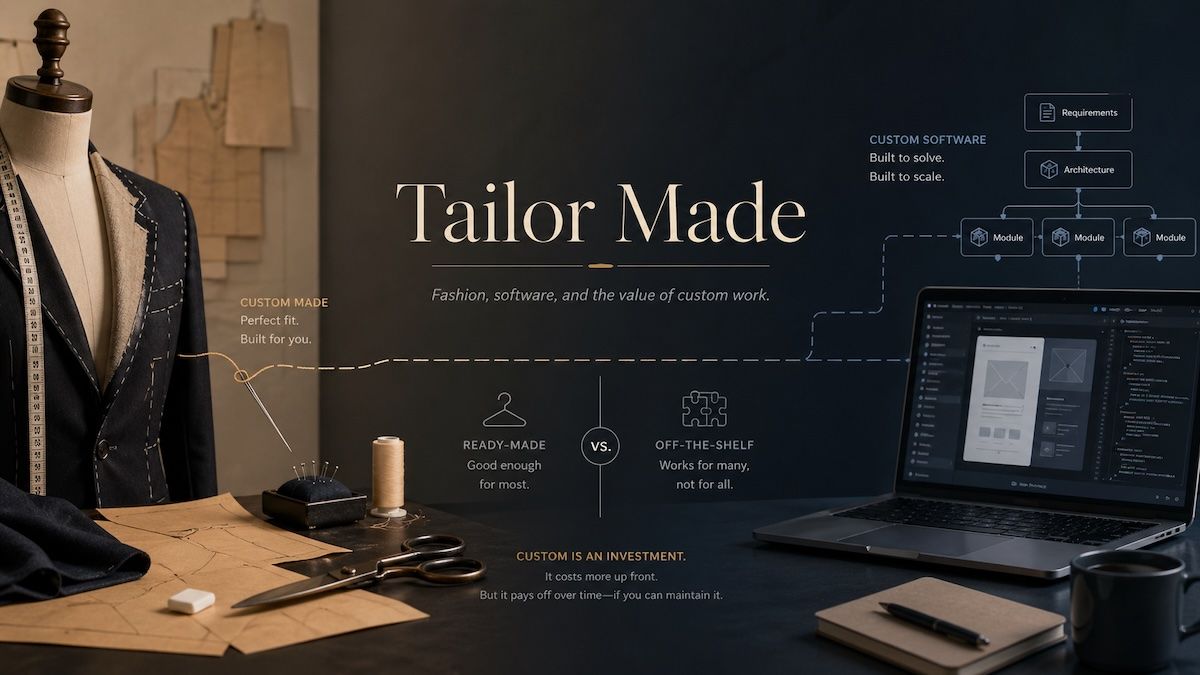
There is an interesting balance in fashion.
Tailors still exist. People still get custom suits, shirts, jackets, and dresses made specifically for their body, taste, and lifestyle. There is still prestige in something being tailor made.
But for everyday life, most of us buy from brands.
We go to Zara, COS, Uniqlo, Massimo Dutti, H&M, or whatever brand fits our taste and budget. The fit may not be perfect, but it is usually good enough. Then we combine pieces, adjust the style, maybe do small alterations, and make it our own.
The fashion industry did not kill tailoring. It just made tailoring less of the default option. I think software is moving in a similar direction.
For a long time, when a business needed software, the instinct was often to build something custom. Something designed from scratch. Something that matched the exact internal process. Something made only for that company.
On paper, that sounds ideal.
The best solution should be the one made exactly for your needs, right?
But in practice, custom software is not just a development cost.
Software needs to be updated. Security issues appear. APIs change. Integrations break. Browsers, operating systems, payment providers, hosting environments, and third-party services keep evolving. Something that works perfectly on day one may need constant attention two years later.
This is where tailor made software becomes expensive.
Building custom software is like buying a custom suit. But imagine that suit needs ongoing adjustments every season. Your body changes, the fabric wears down, buttons fall off, and the style needs to adapt. At that point, you do not just need a suit. You need access to a good tailor over time.
For those who can afford it, tailor made software still makes a lot of sense.
Large companies, businesses with unique operations, or teams that use software as a real competitive advantage can benefit from custom systems. They do not want to shape their process around the limitations of existing tools. They want the software to fit their process.
And that can be powerful.
But only if they can also afford the ongoing maintenance, the team, the technical decisions, the security work, and the future evolution of that system.
Not everyone needs that.
For many businesses, ready-made products, SaaS tools, WordPress plugins, Shopify apps, no-code platforms, or open-source systems are not only enough, but often better.
They are built around common needs. They are improved over time. They are tested by many users. They receive updates, documentation, and support. They benefit from a much larger ecosystem than a one-off internal tool usually can.
Just like a well-made jacket from a good brand can be the better choice for most people’s daily life, a good off-the-shelf software product can be the better choice for most businesses.
The key is not to confuse ready-made with low quality.
Ready-made fashion can still be stylish. You can choose the right pieces, combine them well, make small alterations, and create your own look. Software works the same way.
A well-chosen stack of products, connected with good integrations and supported by a few custom touches, can be much healthier than building everything from scratch.
Maybe the future of software is not fully custom or fully off-the-shelf.
Maybe it is more like a curated software stack.
You choose the right tools, connect them thoughtfully, customize where it actually matters, and maintain the system in a sustainable way.
In fashion, not everyone wears a fully custom wardrobe. But not everyone looks the same either. People build their own style from available pieces.
Software may follow the same path.
Tailor made software will still exist.
Just like tailors still exist.
But it will mostly make sense for those who can truly afford it. Not only the initial build, but the long-term maintenance, operation, and evolution.
For everyone else, the goal may not be to build the most custom thing possible.
It may be to choose the right pieces, combine them well, and create a system that actually fits.
The future of software may not be fully custom or fully off-the-shelf.
It may be about knowing what deserves to be tailored, and what should simply be bought, combined, and maintained well.


Leave a Reply